Tuesday, September 13, 2011
Chapters 6 & 7/Cultural Roots
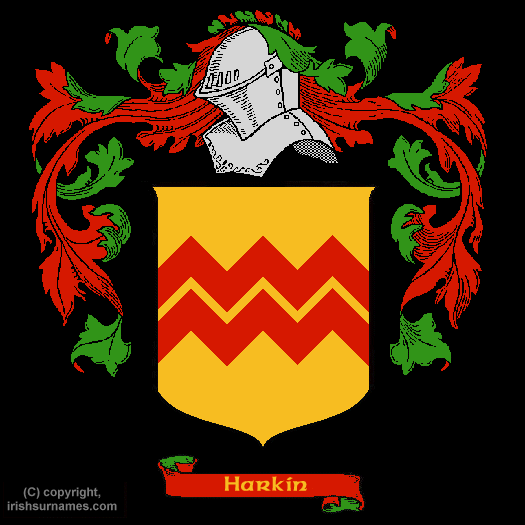
So, who am I? The obvious answer is that I am Angela Marie Harkins. Even this—as un-elucidating as it might seem—tells you a lot more about me than you think. Angela is a name meaning angelic, and it hints at a Christian familial background. Marie is my Mammaw’s name. My mom said she added it to make sure I took after her mom a bit. I could be as angelic as I wanted—but I better have a little fire and stubbornness as well. Lastly, I have my surname Harkins. Harkins is an extremely Irish name. It was originally O’hEarcain meaning son of red or redhead as we still have a lot of redheads in our family tree. There are legends and stories about the O’hEarcains. We were generals—leaders but not princes—and as far as I know, there isn’t a generation that has gone by without a good many Harkins in the military. Originally from Inishowen in County Donegal, the potato famine of 1845 saw the family trading one end of the Appalachian Mountains for the other as they moved from near the Giant’s Causeway to Northern Georgia. This is my culture and it shapes my thoughts on kinship and society.
How does my culture create my kinship? As Lewis explains in Cultural Anthropology, there are two basic classifications for family types: Eskimo and Iroquois. Like most Americans of European descent, my family type is of the Eskimo variety. That is, kinship terms are the same when referring to either my mother’s or father’s side of the family. Also, being of Irish descent means that we are mostly patrilineal, “in which kinship is traced through the male line” (129). This means that the women “marry out” and take on the surname of the spouse while the male heir “carries on the name.” Also, we have an Inuit–like determiner for kin. That is, those who act like family are true family. We might disown someone who does not act like family or kind of adopt someone who is as close as family. I have a third grandma we adopted in because she’s so awesome. We also practice formal adoption—a practice which dates back to clans. My brother is actually my half-brother by my mom. My dad adopted him, and he’s just considered my brother. He’s true family.
What is my household and domestic life pattern? Like a lot of cultures—Spanish cultures, for instance—my family tends to live in the same area. I can literally walk to my Granny and my Mammaw’s house. I did it just this weekend, in fact. My nieces and my brother live in the same house as my parents until they can afford their own house which will most likely be in the same county. My dad lived with his parents before he bought the land we live on now and built our house. I plan to hang around after college until I can buy my own place. I’ve never heard of anyone in our family having a mortgage. So, we’re extended family, and we’re very matriarchal in the household. My Granny, my Mammaw, and my Mom are the rallying points for family gatherings. Sometimes we even have holidays at my place. This is as much out of practicality as it is a testament to their fortitude. Men biologically, especially back in the day, just don’t live as long. I have three Grandpas that are no longer alive.
How are kinship and households changing in my time? Well, to begin with, the location of my family is spreading out a bit into other parts of the Southeast. Cohabitation is a more valid—but still frowned upon by the older or more conservative members—lifestyle choice, and children born from cohabitation are considered legitimate. My mom cohabitated with my brother’s dad. My brother cohabitated with my nieces’ moms. Household, as I talked about earlier, hasn’t changed much. The household is an extended one and the women tend to be the leaders. Although, a bit more of the child rearing responsibilities have been handed off to the men. The whole family pitches in to take care of the youngest generation instead of using nannies or daycare. The older generation is taken care of by the younger generation instead of going into retirement villages or whatever those things are. The most drastic change has been in waiting to get married and have kids until an older age and then having less kids. My Granny, for instance, married early and had 9 kids. My Mammaw also married early and had 7 kids. My brother cohabitated at a later age and had 3 kids.
So, there is my kinship system in all of its shining glory. I suppose we’re pretty representative of most Irish-Americans. Even other Americans of Spanish descent seem to have a similar kinship system even though they come from a completely different background. In the end, probably the least similar kinship system is the one of the modern American portrayed in the media—living away from family, being a divorced/single parent, interacting with mostly the grandparents, not being expected to support the older/younger extended family.
Tuesday, August 30, 2011
Chapitre un et deux!
So, I am actually enjoying the textbook for my Intercultural Communication class. (C’est incroyable, I know!) My opinion of the book, though, is not a shocker to those who know how much I love the show Bones. After all, the book is called Cultural Anthropology. What’s not to love?! A pretty relevant question came up in the first couple of pages of the book, however:
“the popular impression of anthropology is based mainly on movies and television shows that depict anthropologists as adventurers and heroes . . . What are your impressions of anthropology? How did you acquire them?” (6-7)
Well…perhaps my viewing pleasures do tend toward geeky adventures such as Stargate SG-1, Stargate Atlantis, and Bones. I have not seen anything in my studies or the readings of the first couple of chapters to disagree with these shows, though. Sci-fi scores again!
First off, Daniel Jackson from Stargate SG-1 is probably the coolest anthropologist ever. Period. In fact if you have not heard of him, you should probably go and read the Wikipedia article about him. Who knows, it might erase a modicum of shame your ignorance has brought upon your familial name. Go on. I’ll wait… Great, you’re back! Because my readers are the brightest, most well read people still ambulatory, I naturally assume that you noticed Daniel Jackson is an archeologist and a linguist. That’s right, folks. You get two anthropology fields crammed into one slightly geeky, ocular impaired individual! Right about now, I bet you’re asking yourself “whoa! So they were, like, teaching me stuff the whole time?” The answer, my friends, is yes. They have indeed practiced their dark, teacher-like chicaneries upon all of you. Fear not, though! Barbara Miller explains quite succinctly what sorts of vast intellect have been visited upon you: “archeology—the study of past human cultures through their material remains . . . linguistic anthropology—the study of human communication, including its origins, history, and contemporary variation and change.” In essence, when the cast of Stargate SG-1 pulled the Stargate out of the sands of Egypt, they were in fact practicing archeology. Later, when SG-1 traveled to distant planets, there was a reason they dragged along a civilian. The team needed Daniel to translate for them as they interacted with the peoples of the different worlds. You see, they all had a familiar lingual background, but the languages had morphed after hundreds of years of separation from the source language. Studying and interpreting those changes was the job of—you guessed it—the best linguistic anthropologist around town.
Later, the spin-off series Stargate Atlantis continued the anthropological intrigues. This time, though, they moved from historical archeology—the time of the Egyptians to present—to prehistoric archeology—the time of the fictional ancients. It is prehistoric archeology because time being studied “concerns the human past before written records” (7). During their travels, the Atlantis team also indulges in a little “cultural anthropology—the study of living peoples and their cultures, including variation and change” (7). Because all humans were created by the ancients, they all come from a similar cultural background but have adapted over millennia of separation. The team meets up with several cultures at varying levels of our own development. For instance, the Genii are a race of people in a developmental stage comparable to America’s own nuclear arms race. On the other extreme are the Wraith. They too originally have human roots. However, human genes combined with the foreign iratus bug and produced a completely new species.
Bones, however, is not a science fiction show. It is, actually, a crime drama show. As it is set in a very close approximation of reality, facts must adhere closer to reality. In fact, Kathy Reichs—producer and writer of the book series—is a forensic anthropologist in reality whereas the main character Temperance “Bones” Brennan is a forensic anthropologist for the Smithsonian Institute in the show. As a forensic anthropologist, Bones is a student of “biological anthropology or physical anthropology—the study of humans as biological organisms, including evolution and contemporary variation” (6). Furthermore, Bones also specializes in “war zone anthropology or research conducted within zones of violent conflict,” often helping to identify genocide victims whose bodies were dumped into mass graves (45). The show displays some of the dangers that anthropology field work presents. Bones actually had a run in with a local gang while she was on a mission on a remote island where anthropologists believed bones could be found that would fill in the gap in the human evolutionary chain. The show also takes on some of the conflicts between government policies and anthropological principles. On several occasions, the FBI director wants cases swept under the rug for political reasons. Bones, however, searches for the truth, putting her subjects before all else.
So, don’t dismiss the educational (eeeh gads!) value of television out of hand. Shows such as Stargate SG-1, Stargate Atlantis, and Bones may look innocuously entertaining, but watch out! They are secretly full of facts and knowledge. They are like the rice in a crunch bar. You’re eating it for the chocolate, but the rice is cool too.
Now I’m hungry.
À bientôt!
Angela
Subscribe to:
Posts (Atom)

