Tuesday, October 25, 2011

Chapters 9, 10, & 11

The most visible cultural differences arise in three basic areas: communication, religion, and art.

The first area, communication, is, in fact, the first way one can usually use to identify a person with a different background than themselves. Language, “a systematic set of symbols and signs with learned and shared meanings,” is the most obvious difference amongst cultures (190). If you and another person don’t speak the same language, then you can tell you are not a part of the same language meaning making group.

Indeed, “ethnocentric” principles come into play when one not only recognizes the different cultures behind languages but also applies a hierarchical class system to which language has priority (194). For instance, Miller says that “although sign languages are complete and complex languages in their own right, they are often treated as second-class languages” (192).

Eurocentrism also exists in language. The current view is that Americans are stupid for being largely monolingual. However, this view fails to take into account that languages are found much closer together in Europe than in America. Thus, languages are learned out of necessity rather than because of the universal higher intellects of Europeans.

Americans, sadly, are also proponents of an ethnocentric ideal, though. They tend to view the language or accents of the newest immigrating group as inferior. I have said before in my blog that my family ditched Gaelic and their Irish accents for just this reason. Immigrants that speak only Spanish, however, have it much harder because they have to learn an entirely new language and are expected to do so as soon as they enter the country. Most people with this American ethnocentric view also refuse to learn Spanish, denigrating the language as gibberish.

There are also gestures—“movements, usually of the hands, that convey meanings. Some gestures may be universally meaningful, but most are culturally specific and often completely arbitrary”—which most people rarely think about (192). Consequently, nonverbal communication can be one of the easiest ways to offend someone from a different culture. (That article is hilarious, by the way.) For instance, how close do you stand to someone? Do you really think about it, or do you just do it? Well, the distance between people is usually a reflexive thing, and when someone invades your bubble, you probably back away. However, in countries such as Spain, they stand much closer together. Thus, if you move away, it is seen as somewhat offensive. It is the equivalent of someone talking to an American but keeping a room’s length between them. You might begin to try to interpret the action within your own shared cultural meanings: “Oh man, I must not have put on enough deodorant today.”

Another sure fire way to offend people is by talking about—you guessed it—religion. I know they say “never talk about religion, sex, or politics,” but, hey, let’s give it a whirl.

First off, what is religion? According to Barbara Miller, “religion consists of beliefs and behavior related to supernatural beings and forces. This definition specifically avoids linking religion with belief in a supreme deity, because some religions have no concept of a supreme deity whereas others have multiple deities” (212). Huh? Basically, all religions believe—and you should know up front that I’m going with magical ponies as a generalization—in a magical pony, many magical ponies, or the disembodied idea of a magical pony. And their pony is pretty much always the best. (In case you were wondering, I’m Buddhist. I hold with the disembodied idea of a magical pony, a.k.a. karma.)

(And why wouldn’t I? She’s clearly so much more stylin’ than your pony.)

In magic versus religion, religion is seen as the higher class belief. This is not surprising as many foundational thinkers were deeply religious. Also, religions have a lot of practitioners that express their beliefs through modern writings. Even Miller refers to a “magical religion in the modern world” as “so-called Wicca” (213).

But, what is the difference between magic and religion? Well, it’s a pretty fuzzy distinction, but Miller quotes Sir James Frazer in saying that magic is “people’s attempt to compel supernatural forces and beings to act in certain ways” while religion “is the attempt to please supernatural forces or beings” (212).

(Magic = I COMMAND YOU TO FLY, PONY!)

(Religion = I will brush your hair if you fly, pony. Pretty please?)

Now, we move on to “expressive culture, or behavior and beliefs related to art, leisure, and play” (236). Let’s jump right in and discuss that age old question.

(How much wood would a woodchuck chuck if a woodchuck could chuck wood? No, I mean the other question. Sadly, woodchucks are still disinclined to chucking wood.)

What is art? Surprisingly, Miller presents one of the best definitions I have heard. She says that “art is the application of imagination, skill, and style to matter, movement, and sound that goes beyond the purely practical” (236). This definition is a lot more inclusive than, for instance, Eurocentric views on high-art being the only true art form.

(You might know it as ‘It’s not art unless someone is naked.’)

It is important to remember that “all cultures have art, and all cultures have a sense of what makes something art versus non-art” (236).

Actually, it is best to remember that cultures have different meanings and values for everything, including communication, religion, and art. So, try not to take yourself too seriously. It is okay to form opinions about these areas based upon the context of your own culture and experience. In fact, I encourage it. However, don’t expect others to conform to your ideas, and don’t vilify them when their ideas conflict with your own.

Sunday, October 2, 2011

My Cultural Roots, Continued

In my previous blog, I detailed my family's Irish-American heritage, and the practices that carried over into our modern day lives.


However, when my family arrived in the United States, our cultural differences were hardly celebrated. They moved, as stated earlier, in order to escape the potato famine. The Great Famine, as it is known in Ireland, was largely a manmade catastrophe. Aside from the potato,
there was a great deal of food—such as beans and wheat—being produced in Ireland. However, the British landowners exported most of their Irish tenants’ food back to Britain, even though the Irish were starving (Corrie). The British did so because they perpetrated this system upon the Irish for many years prior without consequence, and they generally considered the Irish to be subhuman. The United States, largely populated by descendants of the English, took a similar attitude to the gangly, starving, “uncultured,” burr tongued immigrants invading New York during the time of the famine. The papers of the era most memorably vilified America’s newest citizens by means of cartoons, often portraying the immigrants as gorillas

(A Dublin famine Irish-American monkey)

In order to fit into their new hostile environment, my ancestors—like many Irish-Americans—tried to abandon a lot of their former cultural practices. The dialect went first as it was the easiest way to single out the Irish from the non-Irish. The accent, however, did not completely disappear because it changed the regional dialects, such as giving the Appalachian accent
harsher R’s. The Gaelic language, on the other hand, did disappear. Irish-Gaelic had already flagged for years under British rule of Ireland. In the new country, without any use for or anyone to teach them the language, Irish-Americans simply lost their native tongue. Many of them, as my family did, also converted to Protestantism. This caused them to abandon the Latin that had been a necessity for church. Class and educational values additionally superseded their own beliefs—though this seemed a welcome change. The British rule in Ireland generally perpetuated a system of British landowners and Irish tenants class system (Corrie). As in many farming societies, the Irish were afforded little opportunity for education and generally saw little point to it. In the United States, however, the class system made social mobility possible—though they began at the lowest possible rung. In addition, the economy and government necessitated higher education. Gradually, my ancestor’s went from farmers, to factory workers, and then to small business owners. Each generation saw an increased level of education ending with myself being the first person in my direct line to attend college.

As I said in my previous blog, probably the least similar kinship and cultural system is the one of the modern American portrayed in the media—living away from family, being a
divorced/single parent, interacting with mostly the grandparents, not being expected to support the older/younger extended family. Furthermore, the current media also portrays all Caucasians
in the same light as the bland, elite, dominant class. Many tend to forget that Irish-Americans escaped from starvation and the life of the tenant farmer to come to the United States where they faced rampant racism. Many forget that it is only within the last fifty years that either an Irish-American or African-American president was elected—and President Kennedy was a descendant of the Ulster-Scots, the ruling class in Ireland (Corrie). In summation, no matter how similar or different Americans may look, beneath our shared culture lies a vast and exciting mixture of unique values.

Bibliography

A Dublin famine Irish-American monkey [Newspaper cartoon]. (n.d.). Retrieved from
http://www.travelgolf.org/images/a_dublin_famine_irish_american_monkey.jpg

Corrie, E. (2011, September 22). Conflict and peacebuilding in Northern Ireland. Lecture
presented at Reinhardt University sponsored by The Year of Ireland Committee and the
Chaplain's Office, Waleska, GA.

Tuesday, September 13, 2011

Chapters 6 & 7/Cultural Roots


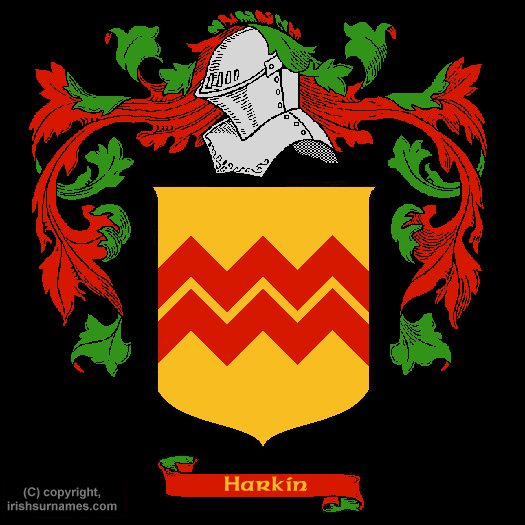
So, who am I? The obvious answer is that I am Angela Marie Harkins. Even this—as un-elucidating as it might seem—tells you a lot more about me than you think. Angela is a name meaning angelic, and it hints at a Christian familial background. Marie is my Mammaw’s name. My mom said she added it to make sure I took after her mom a bit. I could be as angelic as I wanted—but I better have a little fire and stubbornness as well. Lastly, I have my surname Harkins. Harkins is an extremely Irish name. It was originally O’hEarcain meaning son of red or redhead as we still have a lot of redheads in our family tree. There are legends and stories about the O’hEarcains. We were generals—leaders but not princes—and as far as I know, there isn’t a generation that has gone by without a good many Harkins in the military. Originally from Inishowen in County Donegal, the potato famine of 1845 saw the family trading one end of the Appalachian Mountains for the other as they moved from near the Giant’s Causeway to Northern Georgia. This is my culture and it shapes my thoughts on kinship and society.


How does my culture create my kinship? As Lewis explains in Cultural Anthropology, there are two basic classifications for family types: Eskimo and Iroquois. Like most Americans of European descent, my family type is of the Eskimo variety. That is, kinship terms are the same when referring to either my mother’s or father’s side of the family. Also, being of Irish descent means that we are mostly patrilineal, “in which kinship is traced through the male line” (129). This means that the women “marry out” and take on the surname of the spouse while the male heir “carries on the name.” Also, we have an Inuit–like determiner for kin. That is, those who act like family are true family. We might disown someone who does not act like family or kind of adopt someone who is as close as family. I have a third grandma we adopted in because she’s so awesome. We also practice formal adoption—a practice which dates back to clans. My brother is actually my half-brother by my mom. My dad adopted him, and he’s just considered my brother. He’s true family.


What is my household and domestic life pattern? Like a lot of cultures—Spanish cultures, for instance—my family tends to live in the same area. I can literally walk to my Granny and my Mammaw’s house. I did it just this weekend, in fact. My nieces and my brother live in the same house as my parents until they can afford their own house which will most likely be in the same county. My dad lived with his parents before he bought the land we live on now and built our house. I plan to hang around after college until I can buy my own place. I’ve never heard of anyone in our family having a mortgage. So, we’re extended family, and we’re very matriarchal in the household. My Granny, my Mammaw, and my Mom are the rallying points for family gatherings. Sometimes we even have holidays at my place. This is as much out of practicality as it is a testament to their fortitude. Men biologically, especially back in the day, just don’t live as long. I have three Grandpas that are no longer alive.

How are kinship and households changing in my time? Well, to begin with, the location of my family is spreading out a bit into other parts of the Southeast. Cohabitation is a more valid—but still frowned upon by the older or more conservative members—lifestyle choice, and children born from cohabitation are considered legitimate. My mom cohabitated with my brother’s dad. My brother cohabitated with my nieces’ moms. Household, as I talked about earlier, hasn’t changed much. The household is an extended one and the women tend to be the leaders. Although, a bit more of the child rearing responsibilities have been handed off to the men. The whole family pitches in to take care of the youngest generation instead of using nannies or daycare. The older generation is taken care of by the younger generation instead of going into retirement villages or whatever those things are. The most drastic change has been in waiting to get married and have kids until an older age and then having less kids. My Granny, for instance, married early and had 9 kids. My Mammaw also married early and had 7 kids. My brother cohabitated at a later age and had 3 kids.


So, there is my kinship system in all of its shining glory. I suppose we’re pretty representative of most Irish-Americans. Even other Americans of Spanish descent seem to have a similar kinship system even though they come from a completely different background. In the end, probably the least similar kinship system is the one of the modern American portrayed in the media—living away from family, being a divorced/single parent, interacting with mostly the grandparents, not being expected to support the older/younger extended family.

Tuesday, August 30, 2011

Chapitre un et deux!


So, I am actually enjoying the textbook for my Intercultural Communication class. (C’est incroyable, I know!) My opinion of the book, though, is not a shocker to those who know how much I love the show Bones. After all, the book is called Cultural Anthropology. What’s not to love?! A pretty relevant question came up in the first couple of pages of the book, however:
“the popular impression of anthropology is based mainly on movies and television shows that depict anthropologists as adventurers and heroes . . . What are your impressions of anthropology? How did you acquire them?” (6-7)
Well…perhaps my viewing pleasures do tend toward geeky adventures such as Stargate SG-1, Stargate Atlantis, and Bones. I have not seen anything in my studies or the readings of the first couple of chapters to disagree with these shows, though. Sci-fi scores again!

First off, Daniel Jackson from Stargate SG-1 is probably the coolest anthropologist ever. Period. In fact if you have not heard of him, you should probably go and read the Wikipedia article about him. Who knows, it might erase a modicum of shame your ignorance has brought upon your familial name. Go on. I’ll wait… Great, you’re back! Because my readers are the brightest, most well read people still ambulatory, I naturally assume that you noticed Daniel Jackson is an archeologist and a linguist. That’s right, folks. You get two anthropology fields crammed into one slightly geeky, ocular impaired individual! Right about now, I bet you’re asking yourself “whoa! So they were, like, teaching me stuff the whole time?” The answer, my friends, is yes. They have indeed practiced their dark, teacher-like chicaneries upon all of you. Fear not, though! Barbara Miller explains quite succinctly what sorts of vast intellect have been visited upon you: “archeology—the study of past human cultures through their material remains . . . linguistic anthropology—the study of human communication, including its origins, history, and contemporary variation and change.” In essence, when the cast of Stargate SG-1 pulled the Stargate out of the sands of Egypt, they were in fact practicing archeology. Later, when SG-1 traveled to distant planets, there was a reason they dragged along a civilian. The team needed Daniel to translate for them as they interacted with the peoples of the different worlds. You see, they all had a familiar lingual background, but the languages had morphed after hundreds of years of separation from the source language. Studying and interpreting those changes was the job of—you guessed it—the best linguistic anthropologist around town.

Later, the spin-off series Stargate Atlantis continued the anthropological intrigues. This time, though, they moved from historical archeology—the time of the Egyptians to present—to prehistoric archeology—the time of the fictional ancients. It is prehistoric archeology because time being studied “concerns the human past before written records” (7). During their travels, the Atlantis team also indulges in a little “cultural anthropology—the study of living peoples and their cultures, including variation and change” (7). Because all humans were created by the ancients, they all come from a similar cultural background but have adapted over millennia of separation. The team meets up with several cultures at varying levels of our own development. For instance, the Genii are a race of people in a developmental stage comparable to America’s own nuclear arms race. On the other extreme are the Wraith. They too originally have human roots. However, human genes combined with the foreign iratus bug and produced a completely new species.

Bones, however, is not a science fiction show. It is, actually, a crime drama show. As it is set in a very close approximation of reality, facts must adhere closer to reality. In fact, Kathy Reichs—producer and writer of the book series—is a forensic anthropologist in reality whereas the main character Temperance “Bones” Brennan is a forensic anthropologist for the Smithsonian Institute in the show. As a forensic anthropologist, Bones is a student of “biological anthropology or physical anthropology—the study of humans as biological organisms, including evolution and contemporary variation” (6). Furthermore, Bones also specializes in “war zone anthropology or research conducted within zones of violent conflict,” often helping to identify genocide victims whose bodies were dumped into mass graves (45). The show displays some of the dangers that anthropology field work presents. Bones actually had a run in with a local gang while she was on a mission on a remote island where anthropologists believed bones could be found that would fill in the gap in the human evolutionary chain. The show also takes on some of the conflicts between government policies and anthropological principles. On several occasions, the FBI director wants cases swept under the rug for political reasons. Bones, however, searches for the truth, putting her subjects before all else.

So, don’t dismiss the educational (eeeh gads!) value of television out of hand. Shows such as Stargate SG-1, Stargate Atlantis, and Bones may look innocuously entertaining, but watch out! They are secretly full of facts and knowledge. They are like the rice in a crunch bar. You’re eating it for the chocolate, but the rice is cool too.

Now I’m hungry.

À bientôt!
Angela